
EXECUTIVE OVERSIGHT | DIGITAL GOVERNANCE
Confidence in your website is not the same as evidence.
And if that confidence comes from being told what you want to hear, it is not confidence at all.
At some point in the last year, someone told you your website was performing well. It may have been your digital team. Your agency. Your CDO. Whoever it was, they had access to data you did not, used language you were not expected to challenge, and gave you a picture of your digital position that felt credible enough to accept.
The question is not whether they were telling the truth. The question is whether they actually knew.
Because the people closest to the work are not the same as an independent view of it. Proximity creates confidence. It does not create evidence. And when those two things get confused, the gap between them is where value quietly drains and risk quietly builds. Not dramatically. Not visibly. Just continuously, without triggering any alert that reaches the people responsible for the asset.
That asset is your website. And in most organisations, it is carrying more commercial consequence than almost anything else on the balance sheet.
The board signs off on financial audit. Who signs off on your digital performance?
The principle is not complicated. Those doing the work should never be the ones to sign off on it. In finance, that is not a preference. It is a requirement. In legal, in risk, in operational governance of any kind, independent assessment is the foundation that makes everything else trustworthy. Not because the people doing the work are dishonest. Because no one can objectively assess their own output. The closer you are to something, the more reasons you find to believe it is right.
The website, the backbone of business competitiveness, the primary channel for revenue, reputation, compliance and investor confidence, has operated outside that principle for its entire commercial existence. Not because anyone decided it should. Because no practical mechanism existed for the board to have genuine, independent oversight without being pulled into technical complexity that was never their role to manage.
So it defaulted to trust. Trust in the team. Trust in the agency. Trust in the report written by the people the report was assessing. And when issues were raised, the response was almost never immediate action. It was challenge. Defence. A technical explanation delivered with enough confidence to make the question go away. Weeks spent proving the report wrong rather than addressing what it found.
The argument costs more than the fix. Every time. And throughout it, the underlying issue continues doing exactly what it was doing before anyone raised it.
This is not a failure of individuals. It is the predictable consequence of asking people to govern something they built, with no independent reference point, and no agreed language for what good actually looks like.
Your website launched. Your agency celebrated. Google had a different view.
Consider a scenario that is not hypothetical. A significant investment in a new website. Enterprise technology. Multiple platforms integrated. A skilled agency delivering the project. A public announcement celebrating the launch, pointing an audience of tens of thousands directly at the new site.
Within hours of that announcement, an independent assessment of the home page returned a Value grade of D and an Integrity grade of E. Page load was slow. Images were misconfigured in ways the browser masked entirely but that Google's crawler identified immediately. The visitor saw nothing wrong. The team saw nothing wrong. The agency had just told the world the site was more engaging, more informative and more efficient than ever.
Google had already started forming a different view.
This is the nature of the gap. The browser renders what it can and shows the visitor a page that looks correct. Google reads what the server actually sends. Those two things are not always the same. The signals laid down in the first hours and days of a new site shape how Google evaluates the entire domain going forward. Issues present at launch do not wait politely to be discovered. They are being factored in from the first crawl, quietly, continuously, without generating a single alert at board level.
Nobody in that organisation was negligent. Nobody was cutting corners. The investment was genuine, the effort was real, and the pride was deserved. But the fundamentals had not been independently confirmed. And the cost of that, in search visibility, in trust signals, in the return on everything that had just been invested, began accumulating the moment the celebration post went live.
For the first time, the board has a mechanism that matches the weight of the asset.
AiSC is an executive oversight platform. Not a diagnostic tool. Not a replacement for the deep technical audits and annual reviews that have their place in a well-run digital operation. Something different. Something that operates at the speed and clarity that genuine board-level oversight demands.
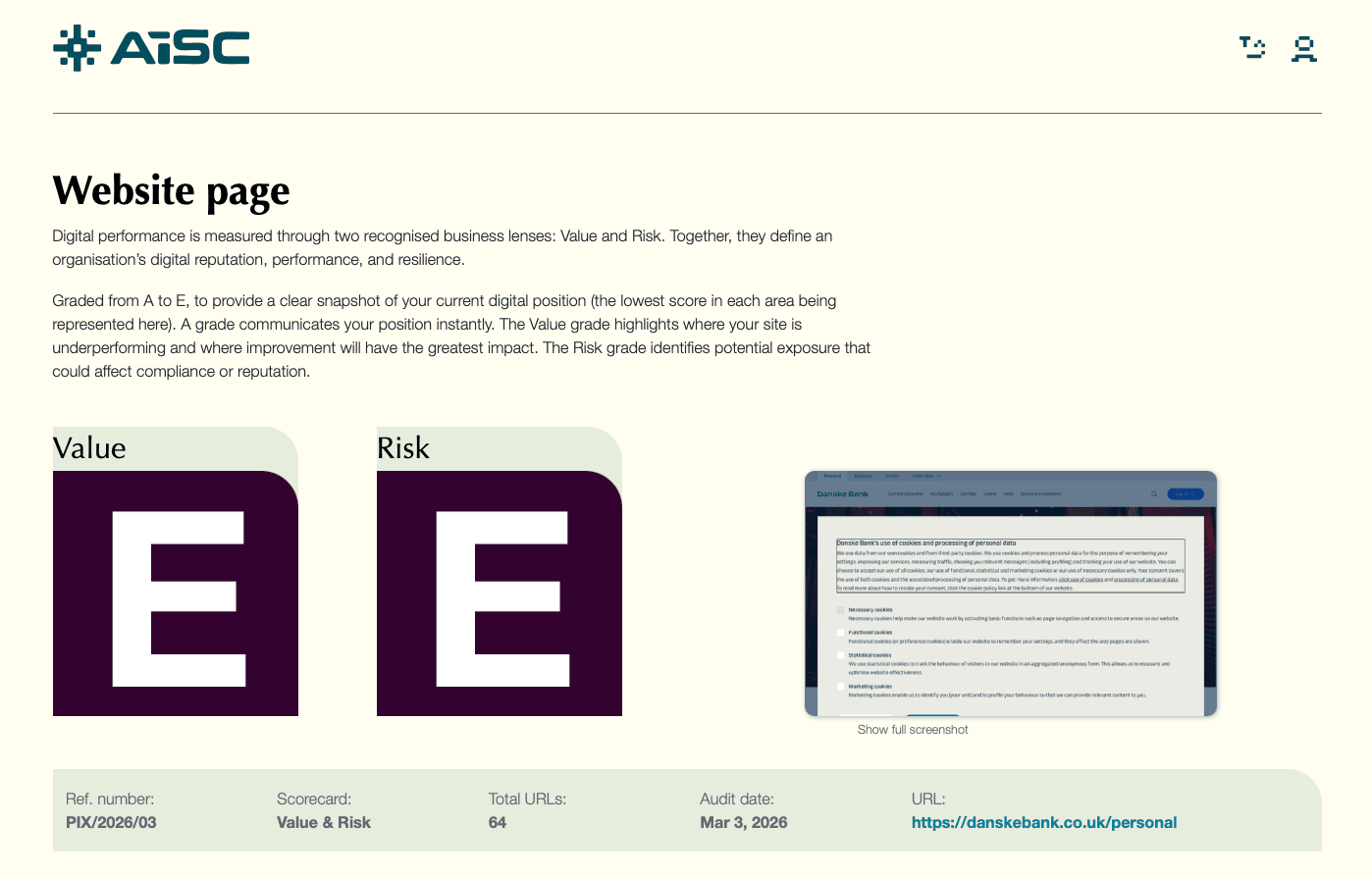
The executive sees their position in 3 seconds. Not a report. Not a briefing prepared by the people being assessed. Two measures, graded A to E, that require no translation and no technical knowledge to understand. Value asks whether the investment is delivering. Whether users can reach what they came for. Whether the site is visible to search or costing the organisation visibility it has already paid to earn. Risk asks whether the organisation is exposed. Whether accessibility obligations are met. Whether data handling is transparent. Whether vulnerabilities are accumulating that nobody has yet been asked to look at.
A means the fundamentals are confirmed. E means they are not. Every board member understands that without explanation. For the first time, the executive has what every other governance function has always had. An independent, clear, immediate view of whether the asset they are responsible for is performing or failing.
Where the grades demand action, the digital manager does not face a volume of undifferentiated findings with no clear path through them. Within 5 seconds of opening AiSC, they set the priorities that reflect the organisation's current reality, regulatory, corporate or industry. They input available resource. AiSC maps that resource to the workload, allocates time to each action, costs the plan, and produces a Work Pack distributed immediately to the right people in the right order. Not a general instruction to improve things. A specific, costed, resource-matched commitment. A promise built on what the organisation actually has available, not on what it would ideally deploy.
That promise can be reported to the board. Tracked. Held. That is governance. Not reassurance.
One of the agencies you did not appoint was already having this conversation.
Think back to the last time you appointed a digital agency. There were presentations. Credentials. Case studies. Pricing conversations. Chemistry. The decision came down to a combination of all of those things, weighted differently by different people in the room.
There may have been one agency in that process that talked about something the others did not. Not just what they would build, but how they would protect the return on it. Lifetime ROI. Ongoing confirmation that the fundamentals remain in place. A framework for Value and Risk that gave you a view beyond delivery. Independent oversight built into the relationship from day one, not bolted on after something went wrong.
At the time, it may have sounded like a longer contract. A higher fee. A level of oversight that felt unnecessary when the more immediate need was a website. So it did not differentiate them enough. And you appointed someone else.
That agency was describing exactly what this article is about. The gap between delivery and confirmation. Between confidence and evidence. Between a celebrated launch and an independently verified one. They were not padding their proposal. They were offering the one thing the others were not. A commercial relationship built on accountability rather than reassurance.
Those agencies are now walking into your competitors' boardrooms with AiSC. They are having a conversation about Value and Risk, independent oversight and the cost of not knowing that your current agency has never initiated. The question is not whether that conversation is happening. It is whether it is happening with you or without you.
The question you now need to answer.
We have spent 25 years measuring digital performance across organisations of every scale and sector. In that time one pattern has remained constant. The executives who believe their website is performing well because they have been told it is, and the executives who know their website is performing well because they have an independent view of it, are rarely looking at the same picture.
The first group has confidence. The second group has evidence.
You already know which of those is worth more. You apply that standard everywhere else in your business without question. The website, the asset that operates every hour of every day, that drives more commercial consequence than most things you formally govern, has until now had no equivalent.
When did you last have an independent view of what your website is actually doing?
Not what you were told it is doing. What it is actually doing.
Find out where you stand. Today.
AiSC gives you an independent Value and Risk assessment of your website, in the time it takes to read this sentence. No briefing required. No technical knowledge needed. Just clarity on where your digital position actually stands, right now, based on evidence rather than reassurance.
Start now at https://aaanow.ai/confirm
